Key Takeaways
- Decaf coffee is never completely caffeine-free. Every decaffeination method leaves behind a very small amount of caffeine.
- A prepared serving of decaffeinated coffee typically delivers a small caffeine range of about 3 to 15 milligrams, depending on brewing style and cup size.
- Typically, decaffeinated coffee delivers only about one-tenth of the caffeine present in a standard cup of coffee.
How Much Caffeine Can You Expect in a Cup of Decaf Coffee?
Understanding decaf coffee caffeine content is essential for anyone concerned about caffeine intake. One of the most common questions people ask about decaf coffee is, “How much caffeine does it actually contain?” Most coffee drinkers know that opting for decaf still leaves a small trace of caffeine in their drink. No matter which decaffeination method is used, it is technically impossible to remove every single caffeine molecule from a coffee bean without also stripping away the flavors that define coffee.
So what does this mean in real life—especially if you’re avoiding caffeine for health reasons, sensitive to stimulants, or simply trying to reduce your intake? Understanding how much caffeine you’re actually consuming becomes important.
In reality, there isn’t one exact figure that applies in every case. The final caffeine content in your cup of decaf depends on many variables, such as the brewing method, the amount of coffee used, and the serving size. Because of these factors, the caffeine level in decaf coffee can vary every single time it is brewed.
What Do Studies Say About Caffeine in Decaf Coffee?
Several peer-reviewed studies support this variation. For example, a 2006 study conducted by the found that brewed decaf coffee contained anywhere between 3 and 15 milligrams of caffeine per cup, depending on whether it was an espresso shot or a larger brewed serving.
Typically, decaffeinated coffee delivers only about one-tenth of the caffeine present in a standard cup of coffee. To put that into perspective, this is usually less caffeine than an ounce of dark chocolate and often less than half the caffeine found in a can of cola.
Why Is Caffeine Content in Decaf Coffee Hard to Measure?
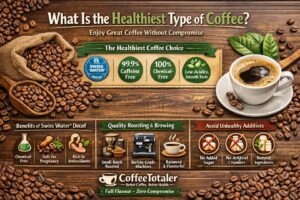
There are several reasons why caffeine levels in decaf coffee are difficult to pinpoint. While decaffeinated green (unroasted) coffee processed using the Swiss Water® Processhttps://www.swisswater.com is guaranteed to be 99.9% caffeine-free, the remaining trace amount can behave differently depending on later stages.
Decaffeination is only one step in the coffee’s journey. After processing, the beans move to roasting, where slight changes in caffeine content may occur.
However, roasting results are inconsistent. Research shows that light, medium, or dark roasts do not reduce caffeine in a predictable way. While roasting may cause minor variations, it generally does not significantly change caffeine levels in decaf coffee.
How Brewing Methods Affect Caffeine Levels in Decaf Coffee?
After roasting, brewing becomes one of the most influential factors in determining how much caffeine ends up in your cup. Even small changes in preparation can alter caffeine content by a few milligrams.
Brewing Method
Different methods—such as espresso, French press, drip coffee, or pour-over—extract caffeine at different rates, directly impacting the final concentration.
Brew Strength and Brew Time
Stronger brews usually contain more caffeine. This can happen when finer grounds are used, more coffee is added relative to water, or the brewing time is extended.
Amount of Coffee Used
Simply using more coffee grounds increases the total caffeine available for extraction, even in decaf coffee.
What Should Caffeine-Sensitive Individuals Consider?
If you are sensitive to caffeine, it’s best to experiment with different decaf beans and brewing methods to identify what works best for your body and daily routine.
While it may be frustrating not to have a single caffeine number that fits everyone, caffeine tolerance is highly individual. Anyone with specific health concerns related to caffeine should consult a medical professional.
Choosing decaf coffee that begins with a 99.9% caffeine-free process, without chemical solvents—such as the Swiss Water® Process—provides a reliable foundation for enjoying coffee with minimal caffeine impact.